“Neither isolated, nor alone”: Insights from the frontlines of women’s end-of-life support InsightsEssays: Civil Society in Japan
Posted on February 12, 2026
Japan NPO Center (JNPOC) has a news & commentary site called NPO CROSS that discusses the role of NPOs/NGOs and civil society as well as social issues in Japan and abroad. We post articles contributed by various stakeholders, including NPOs, foundations, corporations, and volunteer writers.
For this JNPOC’s English site, we select some translated articles from NPO CROSS to introduce to our English-speaking readers.
“Neither isolated, nor alone”: Insights from the frontlines of women’s end-of-life support
As we enter our 30s, it is not uncommon to feel a sudden wave of anxiety or loneliness about the future. Thoughts like “My parents won’t be around forever,” “Will I be living like this alone?” or “Who can I turn to in an emergency?” may cross our minds. Even for those with partners, the “what if” of one day being left alone can be a lingering concern.
With women typically having longer life expectancies, the prospect of living solo in later years feels especially daunting for many. In this article, we speak with Ms. Mieko Jouke, Chairperson of NPO Sakuranbo-no-kai (literally, “The Cherry Club”—symbolizing a gathering of pairs or clusters of people, a Nagoya-based organization dedicated to “women supporting women” in their end-of-life planning.
“If it doesn’t exist, I have to create it”: The story behind the organization’s founding
The inspiration for Jouke to establish NPO Sakuranbo-no-kai came from her personal experience caring for her mother, who had dementia.
Although Jouke was already a legal expert as a Shiho-shoshi—a legal specialist in Japan focused on property registration and inheritance—becoming a caregiver changed her perspective. She realized that “a legal professional can only cover a small fraction of end-of-life planning. Outside of my specialty, I knew almost nothing about the day-to-day realities of care.”
At the time, Jouke searched for a supportive community in Nagoya where women could talk openly and feel at ease discussing the challenges of caregiving and end-of-life planning. While such services existed in Tokyo, there was nothing available in her city. Driven by the thought, “I need someone to talk to—and if that place doesn’t exist, I’ll have to create it myself,” she took the first step toward launching her own organization.
“Looking back, I’m not even sure where all that energy came from,” Jouke says with a lighthearted smile. “I was spending every spare moment recruiting founders and handling the paperwork to get the NPO started. It was an almost abnormal level of intensity, but I think you need that kind of momentum to build something from scratch.”
At around the same time, life became even more demanding as her father also began to require care alongside her mother. Despite the whirlwind of managing her professional workload while caring for both parents, these lived experiences became the fuel for her mission. The desire to “create a supportive environment where women can easily consult one another about end-of-life planning” was no longer just an idea—it became the force that drove her forward.
Connected by a simple “Good Morning”: Finding social fulfillment
Today, the core of NPO Sakuranbo-no-kai’s activities revolves around monthly events. Every initiative is infused with Jouke’s unwavering commitment to “creating a place where members can gather” and her motto: “Neither isolated, nor alone.”
One of the most striking examples of this philosophy is the “Ohayou (Good Morning) LINE” service designed for members living alone. The system is simple yet profound: members post a digital sticker on the LINE messaging app as soon as they wake up. If a sticker isn’t posted by 1:00 PM, a member on duty reaches out to check on them. If they still cannot be reached, the organization contacts their pre-registered emergency contact. While Jouke participates in the group herself, she emphasizes the importance of the collective effort: “The real meaning lies in the fact that everyone in the group takes turns looking out for one another.”
“When it’s your turn to be on duty, you find yourself checking your phone throughout the morning, waiting for those stickers to arrive by 1:00 PM,” Jouke explains. “I believe that the feeling of ‘I am being useful to someone else’ leads to a deep sense of fulfillment—the realization that you are truly a vital part of this community.”
By having the members themselves take on the duty rather than outsourcing it, they become active participants rather than passive recipients of a service. This shift fosters a genuine sense of social contribution. It reaches into a “domain of human connection” that corporate monitoring services simply cannot touch, prioritizing the heart of the relationship over mere safety checks.
A simple step toward “Neither isolated, nor alone”
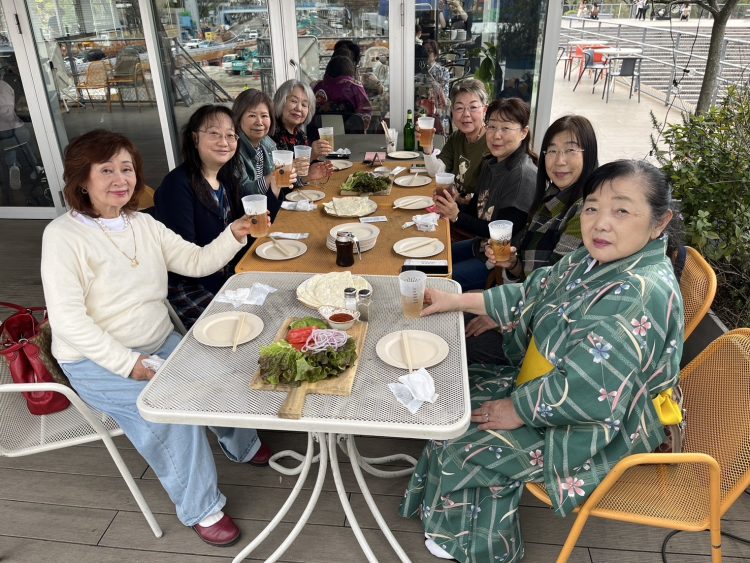
Second from the left in the front row: Mieko Jouke, Chairperson of Sakuranbo-no-kai
The monthly events feature a wide range of study sessions—from drafting wills and dementia prevention to self-defense and learning how to use smartphones. However, Jouke makes it a rule to always pair these sessions with a group meal.
“A member living alone once murmured to me, ‘It’s been a long time since I’ve had a proper meal.’ Those words pierced my heart,” Jouke recalls.
“Sometimes we go out for French or Italian lunches. Since these are the kinds of restaurants many wouldn’t visit on their own, the members put on their makeup and dress up for the occasion. It’s hard to create these moments when you are by yourself. That’s when I realized that simply going out for a meal together is, in itself, a vital form of support.”
During the lunch following a study session, conversations flow naturally: “What did you think of that talk?” or “Here is how I handle that.” In this relaxed atmosphere, members feel free to voice the anxieties they carry in their daily lives, often met with a chorus of “Me too!” and shared laughter. Jouke explains that these “casual interactions” are the true purpose of the gatherings.
“We are a community of like-minded people who feel at ease with one another, enjoying a meal in a friendly, harmonious atmosphere,” Jouke says with a smile. “While the study sessions are important, I always tell them, ”Why don’t we just meet for lunch once a month?” Her joyful expression as she speaks perfectly reflects the warm, welcoming spirit of Sakuranbo-no-kai.
Having a place for such casual interaction and maintaining these “loose yet steady connections” is essential to creating a circle where no one is left behind.
Creating a space of comfort and ease: The reason behind the women-only approach
Sometimes, people ask about NPO Sakuranbo-no-kai, “Can’t men participate too?” However, the decision to keep the organization reserved for women is not about exclusion based on gender. It stems from Jouke’s deep desire to “create a place where women can gather with total peace of mind and feel completely at ease.”
“Having attended an all-girls high school, I personally know how relaxed an environment can be when it’s just women,” Jouke explains. “For instance, when a group is all women, everyone tends to speak up freely. But if even one man is present, some might hesitate to share their thoughts. I believe the same is true for men—they might find it harder to talk openly if a woman is in their group.”
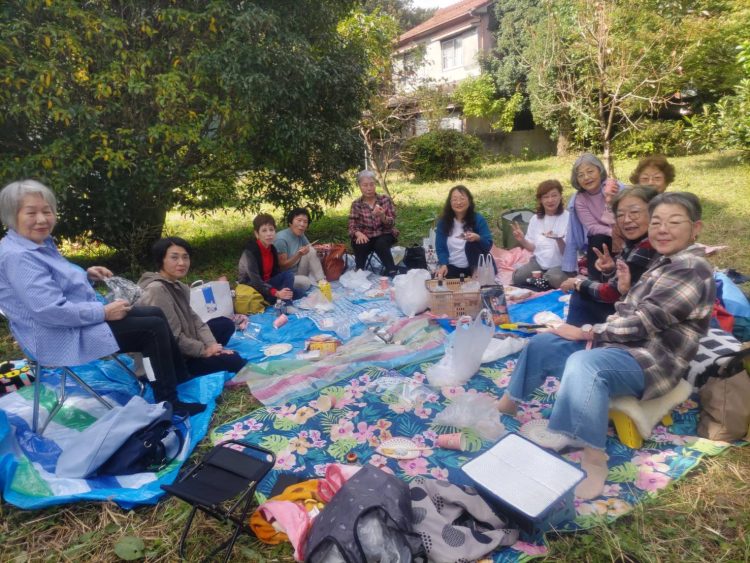
Based on her own experiences, Jouke chose the women-only format as a deliberate way to ensure a “safe and secure environment.” However, this doesn’t mean men are completely excluded. Male friends and family members of the organization’s members are welcome to join open events, such as barbecues and cherry blossom viewing parties.
Loose connections and casual conversations: A step toward a society where we are “Neither isolated, nor alone”
As we enter our 30s, many Japanese women find themselves wondering, “Should I get married?” or “Should I find a steady partner?” These thoughts often stem from an underlying anxiety about facing a long life alone. Until I began interviewing for this story, I believed that as long as one maintained an independent spirit and a healthy body, it was possible to lead a fulfilling life despite occasional feelings of loneliness.
However, speaking with Jouke shifted my perspective. I realized that what what truly brings meaning to our lives is the “fulfillment found through social participation” and a “place where one can speak with peace of mind.” Whether we choose to live alone or with others, having loose yet meaningful connections—like those found at Sakuranbo-no-kai—where we can participate in society while enjoying casual conversation, is a vital step toward a society where we are neither isolated, nor alone—a world where, truly, no one is left behind.
Original text by Makoto Utsumi, JNPOC’s volunteer writer, originally posted on January 20, 2026.
Recent Articles
- Our vision for the future of private NPO support centers
- “Neither isolated, nor alone”: Insights from the frontlines of women’s end-of-life support
- Changing society from within a 15-minute walk
- How are NPO support centers balancing staff protection and abusive behavior?: Strategies for managing customer harassment
- A view on realignment in U.S. private philanthropy
- Adapting global goals to local action: The SAVE JAPAN Project approach